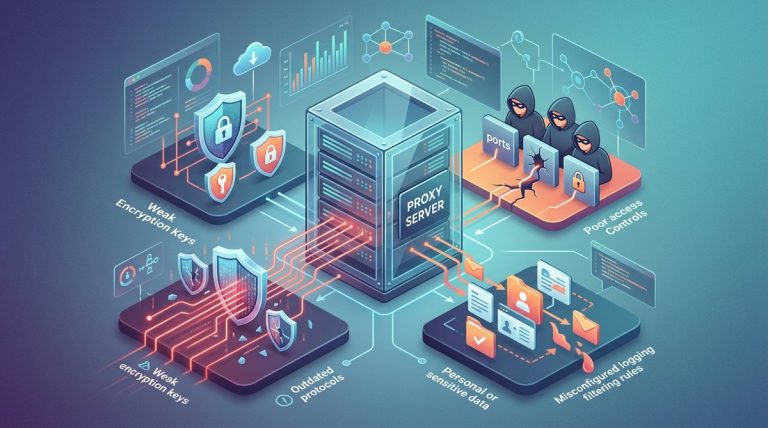
You just finished setting up a new proxy server for your corporate network. Everything looks solid. But one overlooked setting could turn that proxy into an open door for attackers. In 2026, proxy server security mistakes are more dangerous than ever because attackers have weaponized AI to scan for misconfigurations at scale. The same tool that protects your users can expose your entire organization if it isn’t locked down properly.
Proxy servers are a critical security layer, but common mistakes like neglecting access controls, leaving default credentials, and skipping TLS inspection create dangerous gaps. In 2026, misconfigured proxies are a prime target for automated attacks. Auditing your proxy settings regularly and following best practices can prevent data leaks, malware outbreaks, and compliance violations.
The Default Credential Trap
One of the most persistent proxy server security mistakes in 2026 is leaving default usernames and passwords on management interfaces. Attackers don’t need to guess. They have databases of factory credentials for every major proxy software. A simple script can find your proxy’s admin panel and log right in.
The fix is straightforward. Change credentials immediately after deployment. Use strong, unique passwords and enable multi factor authentication. If your proxy platform supports it, integrate with your existing identity provider for single sign on.
Misconfigured Access Control Lists
Access control lists are powerful. They define which IP ranges or users can send traffic through the proxy. But many IT teams set them too broadly. A rule that allows “any” source IP from the internal network can let a compromised workstation tunnel malicious traffic out of your network.
Worse, some administrators leave ACLs wide open for testing and forget to tighten them. In a 2026 threat landscape, every exposed port is a potential entry point.
- Check each ACL rule for overly permissive ranges.
- Remove any rule that uses 0.0.0.0/0 or equivalent.
- Segment your proxy by network zone. Only allow traffic from specific subnets that need it.
- Review ACL changes in your change management logs.
- Use a tool to automatically scan for overly permissive rules.
Skipping TLS Inspection
Proxies that don’t decrypt and inspect HTTPS traffic are blind to the majority of web threats. Attackers know this. They deliver malware through encrypted channels because they expect your proxy to pass the traffic through without checking it.
Enabling TLS inspection is one of the most effective security measures you can take. But it must be done correctly. Deploy a trusted internal certificate authority to all endpoints. Configure the proxy to re encrypt traffic after inspection. Test thoroughly to avoid breaking applications that rely on certificate pinning.
| Mistake | Impact | Fix |
|---|---|---|
| Default credentials | Full admin access | Change immediately, enable MFA |
| Overly permissive ACLs | Unauthorized traffic tunneling | Segment by subnet, remove broad rules |
| No TLS inspection | Blind to encrypted threats | Deploy internal CA and enable inspection |
| Outdated proxy software | Known vulnerabilities exploited | Apply patches within 24 hours |
| No logging or monitoring | Cannot detect attacks | Enable detailed logging and feed to SIEM |
Ignoring Software Updates
A proxy server that runs outdated software is a ticking time bomb. Threat actors in 2026 are ruthless about exploiting known vulnerabilities. They scan for unpatched proxies within hours of a CVE being published.
This mistake is easy to fix. Subscribe to security advisories for your proxy software. Automate patch deployment where possible. For critical vulnerabilities, have a process to apply emergency patches outside the normal change window.
- Identify all proxy servers in your environment.
- Compare their versions against the latest stable release.
- Apply patches to non production proxies first.
- Test for regressions with your most critical applications.
- Roll out the update to production in a staggered window.
Neglecting Logging and Monitoring
A proxy without logs is a black hole. You cannot detect compromised devices that are using the proxy to exfiltrate data or connect to command and control servers. This mistake is especially common in smaller IT teams that set up a proxy but never configure centralized logging.
In 2026, security operations centers rely on proxy logs to spot anomalies. A user who suddenly starts accessing unusual domains or downloading large files at 3 AM is a red flag. Feed your proxy logs into a SIEM and set up alerts for behavioral triggers.
“A proxy server that you don’t monitor is just another network appliance waiting to be hijacked. Treat it like a firewall. Audit it, log it, and review the logs weekly.” — Senior Security Architect, Fortune 500 enterprise
Exposing the Management Interface
Some proxy servers have a web based admin panel that should never be reachable from the internet. Yet we still see deployments where the management interface listens on a public IP or is accessible via a simple port scan. This is one of the most dangerous proxy server security mistakes in 2026.
Bind the management interface to a dedicated management VLAN. Use a jump box or VPN to access it. If your proxy supports API based management, restrict API keys to specific source IPs and use short lived tokens.
For a deeper look at building a resilient proxy architecture, see our guide on optimizing proxy server performance for enterprise networks. It covers network segmentation and load balancing considerations that also improve security.
Using a Reverse Proxy Without Web Application Firewall Rules
Many teams deploy a reverse proxy in front of a web application to handle SSL termination and caching. But they forget to add web application firewall rules. In 2026, that proxy becomes a target for SQL injection, path traversal, and other application layer attacks.
The reverse proxy should inspect request payloads, block malicious patterns, and enforce rate limits. Combine it with a dedicated WAF or enable built in rules if your proxy supports them.
Learn more about deploying a secure reverse proxy in our post on how to deploy a reverse proxy for improved network security. It walks through the essential WAF configurations.
Sticking with HTTP Instead of SOCKS5 When Appropriate
Not all proxy protocols are equal. HTTP proxies are great for web traffic but struggle with non HTTP protocols like SSH, SMTP, or custom applications. If you force everything through an HTTP proxy, you may bypass your security controls entirely by using tunnelling methods.
For applications that need full TCP support, consider SOCKS5. It handles any protocol without interfering with the data stream. Just remember that SOCKS5 proxies do not inspect content. Use them only for trusted applications that cannot use HTTP.
Before deciding, compare SOCKS5 vs HTTP proxies which one should you use for secure browsing to match your use case.
Not Planning for Failover
A single proxy server is a single point of failure. If it goes down, all internet traffic for your organization stops. Some teams skip redundancy to save money, but the security consequences are real. Users may disable the proxy or connect directly to the internet to get back to work, bypassing all security controls.
Design a high availability proxy cluster. Use a load balancer or floating IP. Regularly test failover to ensure it works.
For a step by step setup, check our guide on how to automate proxy server failover for high availability. It includes configuration examples for common proxy software.
Your Proxy Audit Checklist for 2026
Building a secure proxy environment is not a one time task. It requires ongoing attention. Use this checklist to spot and fix proxy server security mistakes in your network today.
- Change all default credentials on proxy management interfaces.
- Review ACLs and restrict source IPs to necessary subnets.
- Enable TLS inspection with a trusted internal certificate.
- Apply the latest security patches to every proxy server.
- Enable detailed logging and send logs to a SIEM.
- Restrict management interfaces to internal VLANs.
- Add WAF rules to reverse proxies.
- Use the right protocol (HTTP or SOCKS5) for each use case.
- Implement high availability and test failover.
For a complete framework, read the ultimate guide to securing proxy servers against modern threats. It dives deeper into each topic and includes real world case studies.
Take Control Before Attackers Do
Proxy server security mistakes in 2026 are not a matter of if but when they will be exploited. The good news is that nearly every mistake listed here is fixable with a few hours of focused work. Start with the most critical items: default credentials and overly permissive ACLs. Then move through the checklist. Your network will be stronger, your users safer, and your compliance posture cleaner. Make the time today.